
How to Safely Ship Laptops and IT Equipment Internationally in 2026
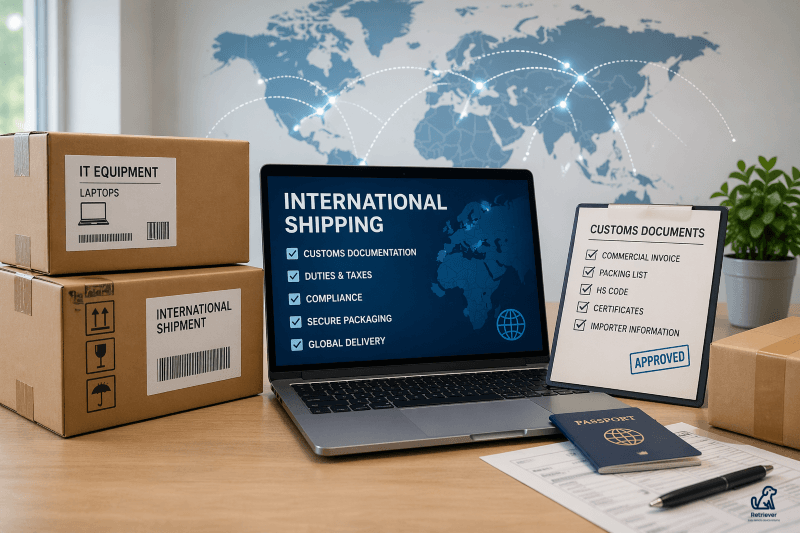
If you’re shipping IT equipment internationally, you already know how much of a headache it can be. It’s definitely not as simple as printing a label and sending it out.
Every country has different requirements, and customs often introduces paperwork, fees, or approvals that weren’t part of the original plan. That’s why shipping laptops and IT equipment across borders usually involves more coordination than most teams expect.
When a laptop is tied to onboarding, a replacement device, or a remote employee waiting to get started, even a short delay creates extra work for IT. And this isn’t becoming less common. According to Gallup, hybrid and remote work continue to be long-term operating models for many organizations, which means more companies are regularly shipping devices across countries and regions.
This guide breaks down what actually matters when shipping laptops and IT equipment internationally in 2026. From international shipping regulations and packing equipment securely to choosing carriers and avoiding the mistakes that cause delays.
Understanding International Shipping Rules for IT Equipment
Domestic shipping is usually pretty predictable. International shipping isn’t. Once that laptop crosses a border, it moves through customs checks, documentation reviews, and country-specific requirements that can vary alot depending on where it’s going.
Laptops and other electronics are treated differently than standard packages. They typically have higher declared value, contain lithium batteries, and may require additional information before they can clear customs.
Lithium batteries are one of the main reasons laptops fall under additional shipping rules. Carriers will often require specific labeling, packaging, and documentation for battery-powered devices, and some countries apply extra restrictions depending on how the equipment is transported.
A few small details can make a big difference in whether a shipment moves quickly or gets held up, including:
customs paperwork accuracy
declared value of the device
product classification (HS code)
country-specific import requirements
battery restrictions for electronics
importer documentation requirements
The challenge is that a shipment can leave perfectly packed and labeled, then stall because one piece of information wasn’t handled correctly. That’s why understanding international shipping regulations upfront matters so much when shipping IT equipment across borders.
Documentation Matters More Than Speed
When international shipments get delayed, paperwork is usually the reason. You could have done everything correct, but if the documentation is incomplete or inaccurate, customs can still stop the shipment from moving.
Most international IT equipment shipments require several pieces of customs documentation, including a commercial invoice. You will also be expected to supply:
an accurate declared value
recipient and importer information
product classification codes (HS codes)
supporting customs documentation when required
Any small error and you are looking at a potential bigger problem. If the declared value doesn’t match the shipment, customs may flag it. If the product classification is incorrect, the shipment may need to be reviewed or reprocessed. This is one of the biggest differences between domestic and international shipping. Fast shipping only matters if the paperwork is right.
Duties, Taxes, and Unexpected Costs
One of the biggest surprises in international shipping is that the shipping label is usually only part of the total cost. Once a laptop crosses a border, import fees often come into play, and those costs will vary depending on the country, the declared value of the device, and how the shipment is classified.
Common charges may include:
import duties based on product category and value
VAT, GST, or regional sales taxes
customs brokerage fees
import processing or handling charges
storage fees if customs holds the shipment
A laptop shipped to one country may clear with little added cost, while the same device sent somewhere else could trigger significant duties or tax requirements.
For example, some countries calculate import costs based on the declared value of the equipment plus shipping costs. Others may require taxes to be paid before the package can move through customs. This becomes really important for companies shipping high-value IT equipment or sending devices regularly across multiple countries.
If responsibilities aren’t clear upfront, shipments often sit in customs while teams determine:
who pays the fees
whether the recipient is responsible
if an importer of record is required
how the shipment should be classified
These delays are avoidable. You just need to plan for all duties, taxes, and import requirements before the device ships.
Country-Specific Rules Change Everything
Country-specific rules are another reason international shipments become unpredictable. Everything from its own customs rules, import thresholds, tax treatment, and documentation requirements can all cause problems. What clears quickly in one market can get delayed in another. That’s especially true with laptops and other electronics, which often involve higher declared values and lithium battery rules.
A better approach is to treat each destination as its own shipping environment and confirm the requirements before the device goes out. The most reliable places to check are:
the destination country’s official customs authority
the carrier’s international shipping guidance
a customs broker or logistics partner handling the shipment
For example, Canada’s customs authority publishes commercial importing guidance, including value-for-duty requirements and country-of-origin rules. In the EU, customs and import VAT formalities can vary by Member State, which is why country-specific review matters before shipping.
How to Package IT Equipment So It Arrives Safely
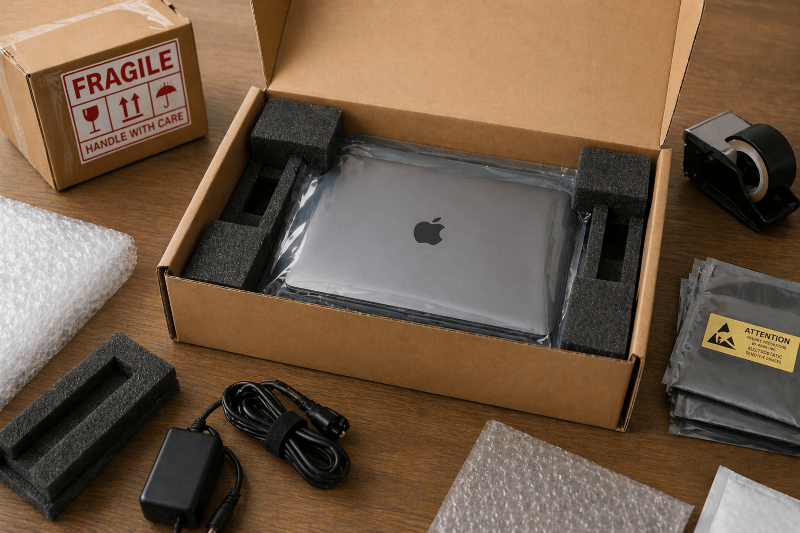
Packaging is one of the few parts of international shipping you can fully control, and it directly impacts whether a device arrives in working condition.
International shipments usually go through more handling like multiple carriers, customs inspections, warehouses, and longer transit times. That means packaging needs to hold up through repeated handling and prevent movement inside the box. For laptops and IT equipment, packaging should focus on stability first.
Good packaging typically includes:
snug internal cushioning so the device cannot shift during transit
reinforced outer packaging that protects corners and absorbs impact
anti-static protection for sensitive electronics
double-boxing for higher-value equipment or long-distance shipments
clear battery and electronics labeling when required by the carrier
One of the most common mistakes is shipping equipment in the original manufacturer box without additional protection. Retail packaging is designed to look good but is not always built for customs inspections, long-distance handling, or multiple transfer points.
International shipments are sometimes opened during customs review, which means packaging should be strong enough to survive being inspected and re-sealed without compromising the device inside.
Small packaging mistakes tend to become much more noticeable once equipment moves internationally. Common issues include:
empty space inside the box
weak cushioning that allows movement
incorrect labeling
thin or fragile outer packaging
missing battery identification when required
A simple way to test packaging is to ask: If this box were opened, re-sealed, stacked, and moved several more times, would the device still stay secure inside? If the answer is no, the packaging likely needs another layer of protection to reduce the risk of damage.
Choosing the Right International Shipping Carrier
Most teams compare carriers based on speed and price. Those matter, but international shipping adds another layer of complexity. A carrier that looks great on paper may perform very differently once customs, regional handoffs, and cross-border logistics come into play.
When choosing a carrier for international IT shipments, it helps to evaluate:
customs expertise in the destination country
international tracking visibility
insurance clarity
claims handling process
regional delivery performance
reliability during customs clearance
Not every carrier has the same strengths internationally. Some perform better in certain regions, while others have stronger customs support or more reliable tracking once a shipment crosses borders.
If you’re shipping regularly to the same countries, it’s worth looking at delivery consistency, customs clearance timelines, and how often shipments require manual follow-up.
In alot of cases, the best carrier isn’t necessarily the one that’s fastest. It’s the one that creates the fewest delays and gives your team the clearest visibility when something needs attention.
International Shipping Doesn’t End at Delivery
Most shipping conversations stop at delivery. For IT teams, that’s usually just the beginning. Eventually, devices need to be:
returned after offboarding
repaired or replaced
redeployed to another employee
securely disposed of at end of life
Laptop Returns are usually harder than outbound shipments. The original packaging may be gone. The employee may be in a different location. Customs requirements can change depending on where the device is returning from and whether it’s classified as a temporary export, company asset, or repaired item.
International retrievals often require:
updated customs documentation
carrier options that vary by country
clear return instructions for employees
visibility into where the device is during transit
a defined owner responsible for coordinating the laptop return
Teams that plan for retrievals before the first shipment goes out usually have fewer delays, fewer lost devices, and less manual follow-up later.
Real-World Scenarios: What International IT Shipping Actually Looks Like
Scenario 1 - Onboarding a New Hire in the UK
A U.S.-based company hires a remote software engineer in London and needs to deliver a pre-configured MacBook Pro within five business days of the employee accepting the offer. To complete the international laptop shipping process, the shipment requires a commercial invoice with the device's declared value, the correct HS code classification for laptops (8471.30), and compliance with UK import VAT requirements following Brexit. Because the company did not confirm whether an importer of record was required before shipping, the laptop is held at UK customs for four additional days, delaying the employee's start date and creating additional work for both IT and HR. By confirming importer-of-record requirements, preparing accurate customs documentation, and verifying all shipping details before the device leaves the United States, the company avoids unnecessary customs delays, improves IT equipment customs clearance, and ensures the new employee receives the laptop on time.
Scenario 2 - Recovering a Device from a Departing Employee in Germany
A global consulting firm needs to recover a company-issued laptop from an employee in Munich after their resignation. Although shipping a laptop to an employee is relatively straightforward, cross-border device recovery often requires additional planning because return shipments must include the correct customs paperwork and clearly identify the laptop as a returning company asset rather than a new import. Without accurate documentation, the package can be delayed in customs or incur unnecessary duties and taxes before reaching the organization's IT team. By providing employees with clear return instructions, prepaid shipping labels, and properly prepared customs documents, organizations can simplify the laptop return process, reduce delays, and improve the efficiency of remote employee device logistics across international locations.
Scenario 3 - Shipping a Replacement Device to a Contractor in Mexico
A contractor in Mexico City experiences a laptop failure while working on a time-sensitive project, and the IT team must ship a replacement device from the United States within 72 hours to avoid disrupting business operations. The shipment requires a commercial invoice, proof of the laptop's declared value, and carrier-compliant labeling because devices containing lithium-ion batteries must meet IATA shipping regulations. Choosing a carrier without experience in Mexico's customs requirements can result in the shipment being held at the border for several days, delaying the contractor's ability to resume work. By working with a logistics provider that understands regional customs requirements, prepares accurate shipping documentation, and follows lithium battery regulations, organizations can speed up IT equipment customs clearance and deliver replacement devices in less than 48 hours.
Scenario 4 - Managing a Multi-Country Equipment Rollout
A company expanding into the Netherlands, Ireland, and Canada needs to ship 40 laptops to new employees across three countries during the same week. Each destination has its own import thresholds, VAT requirements, customs documentation, and delivery regulations, making it difficult for IT teams to coordinate multiple international laptop shipping projects at once. Managing each shipment through separate carriers increases the risk of documentation errors, inconsistent tracking, and customs delays. By working with a logistics partner that provides country-specific expertise and centralized shipment management, organizations can simplify remote employee device logistics, improve visibility across every shipment, and reduce average customs clearance times by approximately 30% compared to managing each shipment independently.
How Retriever Supports International Device Logistics
How Does Retriever Handle International IT Equipment Shipping?
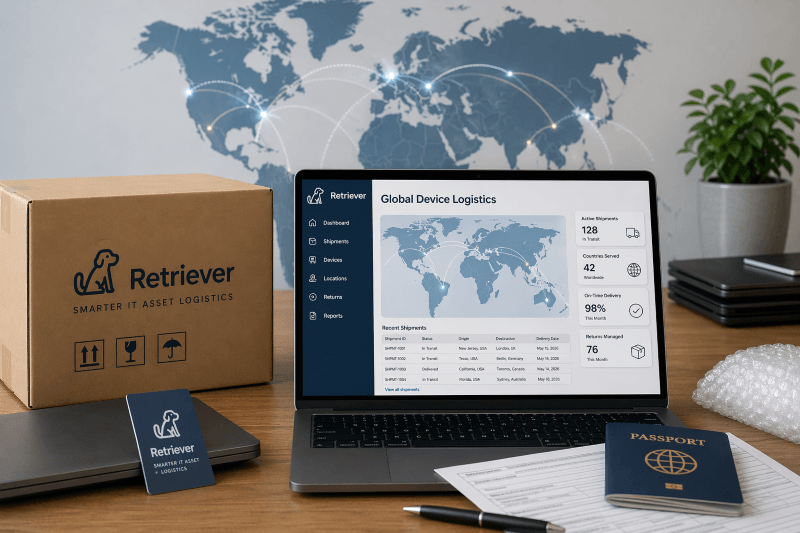
International device shipping gets complicated when every shipment involves different carriers, customs requirements, duties, taxes, and country-specific rules. Retriever gives IT teams a single, hands-off process for managing international device shipments, deployments, returns, and retrievals without coordinating those logistics themselves.
Retriever provides international device retrieval and deployment in countries around the world. The cross-border process is managed on the customer's behalf, including shipping, customs documentation, duties and taxes, packaging requirements, tracking, and other international logistics.
Retriever supports international device operations including:
shipping laptops and IT equipment to employees internationally
retrieving equipment from employees in other countries
managing customs documentation and cross-border shipping requirements
handling duties and taxes
providing shipment tracking and device visibility
supporting international onboarding, offboarding, and device recovery
routing returned equipment to the appropriate next stage of its lifecycle
Retriever's quoted international pricing includes the shipping, duties, taxes, and customs-related costs associated with the service. Delivered Duty Paid (DDP) shipping is used where applicable, helping give organizations a clear upfront cost while Retriever manages the cross-border process.
For IT teams supporting employees across countries, this means international device logistics can remain as hands-off as a domestic Retriever request. Instead of coordinating carriers, customs requirements, employees, and separate vendors, IT teams can use Retriever to manage the process from deployment or retrieval through the device's next lifecycle stage.
10 Essential Questions to Ask Your Shipping Provider
Before choosing a provider for international IT equipment shipping, it helps to ask questions that go beyond pricing and delivery speed.
These conversations often reveal how well a provider handles customs, packaging, visibility, and long-term logistics support.
How do you handle international shipping regulations for IT equipment?
What documentation is required when shipping laptops internationally?
How do you manage duties, taxes, and customs fees?
What happens if a shipment gets delayed in customs?
How do you approach packing equipment securely for international transit?
Do you follow lithium battery shipping requirements?
How do you provide shipment visibility after equipment crosses borders?
What insurance coverage is available for IT equipment shipping?
How do you handle international laptop returns or retrievals?
What countries or regions do you have the most experience shipping to?
The answers usually make it pretty clear whether a provider can handle more than just getting the shipment out the door.
Frequently Asked Questions: Shipping IT Equipment Internationally
What documents do I need to ship a laptop internationally?
Most international laptop shipments require a commercial invoice that includes the device's declared value, the recipient's complete contact information, the importer's details, and the correct HS (Harmonized System) code for the laptop, which is typically 8471.30. Depending on the destination country, you may also need supporting documentation such as a packing list, certificate of origin, import permit, or other customs forms. Missing or inaccurate paperwork is one of the most common causes of customs delays, unexpected fees, and shipment holds. Before shipping, verify the destination country's documentation requirements and review every document for accuracy to help ensure the laptop clears customs without unnecessary delays.
What are import duties for IT equipment shipped internationally?
Import duties for IT equipment are typically calculated as a percentage of the device's declared value, although some countries also include shipping and insurance costs when determining the total customs value. The amount owed depends on the destination country's import regulations, the product's HS classification, and any applicable trade agreements. In addition to import duties, many countries charge VAT, GST, or other taxes that increase the total landed cost of the shipment. Reviewing the destination country's customs requirements before shipping helps organizations estimate costs accurately and avoid unexpected charges when the equipment arrives.
Can I ship a laptop with a lithium battery internationally?
Yes, but laptops containing lithium-ion batteries are subject to additional international shipping regulations because lithium batteries are classified as hazardous materials for transport. Depending on the carrier, destination country, and shipping method, the package may require specific labeling, documentation, and packaging that complies with IATA or other applicable transportation standards. Some carriers also impose restrictions based on battery watt-hour ratings or limit certain shipping routes. Before shipping, confirm your carrier's current lithium battery requirements to help prevent delays, rejected shipments, or customs issues.
What is an importer of record, and do I need one?
An importer of record (IOR) is the individual or organization legally responsible for ensuring imported goods comply with the destination country's customs regulations and for paying any applicable duties, taxes, and fees. When shipping IT equipment internationally, an importer of record may be required if your company does not have a legal presence in the destination country. Without an importer of record when one is required, shipments can be delayed, held by customs, or refused entry altogether. Before shipping, confirm the destination country's requirements and determine whether your organization or a logistics provider can serve as the importer of record.
How do I ship a laptop back from an international employee after offboarding?
Shipping a laptop back from an international employee typically requires updated customs documentation, especially if the device was originally exported from another country. To help avoid unnecessary import duties, the return shipment should clearly identify the laptop as a returning company asset rather than a new import whenever applicable. Providing the employee with prepaid shipping labels, clear packing instructions, and the required customs paperwork helps simplify the laptop return process and reduces the risk of delays. Before the shipment is sent, confirm the return classification and documentation requirements with your carrier or customs broker to help ensure the device clears customs efficiently.
Which countries are most complex for international IT equipment shipping?
Countries with strict import regulations, extensive customs documentation requirements, or importer of record obligations are generally the most complex destinations for international IT equipment shipping. Requirements vary by country and may include additional permits, certifications, taxes, or restrictions that can affect clearance times and overall shipping costs. Because regulations change over time, organizations should verify the latest customs requirements before shipping and work with an experienced international logistics provider when shipping to more complex destinations. Planning ahead helps reduce delays, avoid compliance issues, and improve delivery reliability.
What Matters Most When Shipping IT Equipment Internationally
International shipping tends to go smoothly when there’s a clear process behind it. The challenges usually show up when shipments are handled differently every time. Different paperwork, different carriers, and different expectations depending on the country.
When documentation is accurate, packaging is consistent, and there’s a plan for both laptop delivery and returns, international shipping becomes much easier to manage. For IT teams supporting employees across multiple locations, the goal isn’t just getting a device delivered. It’s having a process that still works when shipments become more frequent, timelines get tighter, and more countries are involved.
If you’re managing international device logistics, Retriever helps support the full lifecycle of IT equipment. From shipping and laptop returns to warehousing, redeployment, and secure disposal.
Laptop Returns – Learn how Retriever manages device recovery from remote employees
Laptop Warehousing & Redeployment – Explore secure storage and redeployment workflows
Secure Data Destruction & Disposal – See how end-of-life devices are securely wiped and documented