
The True Cost of Laptop Returns in 2026: A Guide for IT Teams
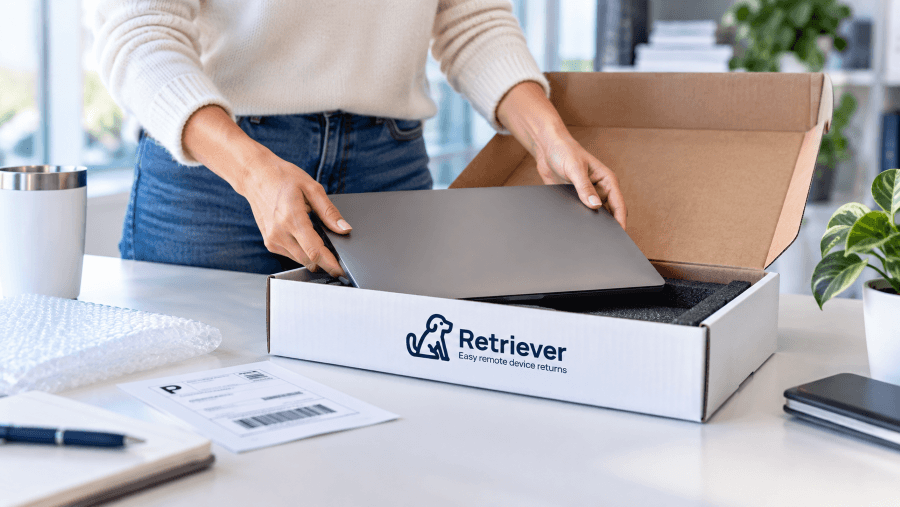
The price of a shipping label does not tell you what it actually costs to recover a company laptop from a departing employee. For companies with a remote workforce, getting a laptop back can take more time and money than expected.
Those costs become even more important at scale. When you’re offboarding dozens or hundreds of employees, inefficient return processes can increase administrative work, delay device recovery, and leave organizations replacing equipment that is still in good enough condition to be reused.
Recovering a laptop also preserves value. Depending on its condition and lifecycle stage, a returned device may be redeployed to another employee, stored for a future hire, sold through a buyback program, or securely disposed of.
This guide breaks down the true cost of laptop returns in 2026, how unsuccessful returns affect asset recovery costs, and how IT teams can evaluate both the cost of recovering equipment and how much they can save by getting those laptops back.
What Is the True Cost of an Employee Laptop Return?
The true cost of an employee laptop return includes packaging and shipping, IT and HR labor, employee communication and follow-up, the cost of devices that are not recovered, and the remaining value of the returned equipment.
There’s also the time spent managing the return. Someone has to coordinate with the employee, track the shipment, follow up if the laptop is overdue, and update records once it comes back.
Then there’s the value of the laptop itself. A recovered device may be redeployed to another employee, kept for a future hire, or sold through a buyback program. If the laptop never comes back, the company loses that option and may need to buy a replacement.
What Costs Are Included in an IT Asset Return?
The costs of an IT asset return can include packaging and shipping, IT and HR labor, employee communication and follow-up, shipment tracking, unsuccessful recovery, and the lost value or replacement cost associated with equipment that is not returned.
Packaging and Shipping Costs
Packaging and shipping are usually the most obvious costs of a laptop return. If you’re managing returns in-house, you may need to pay for a properly sized box, protective materials, tape, and the shipping label itself. That cost can go up with expedited shipping, insurance, signature confirmation, or international returns.
IT and HR Labor Costs
IT and HR labor can add a significant amount to the cost of a laptop return. Someone has to create the label, arrange the packaging, send return instructions, track the shipment, update asset records, and process the laptop when it arrives.
That may not sound like much for one laptop. But when you’re offboarding dozens or hundreds of employees, all of that staff time adds up quickly.
Employee Communication and Follow-Up Costs
Employee communication and follow-up add to return costs when laptops don’t come back after the first request. IT or HR may need to send reminders, answer questions, resend labels, replace packaging, or keep following up on an overdue device.
The more manual the process is, the more staff time gets spent chasing returns instead of working on other priorities.
Unreturned Device Costs
An unreturned laptop can cost a company much more than the shipping expense. The business loses control of the device and may need to purchase another laptop to replace it.
But the financial impact isn’t necessarily the laptop’s original purchase price. Its age, condition, remaining useful life, and potential resale or redeployment value all matter when determining what the company actually lost.
Recovered Asset Value
A recovered laptop can still provide value after the original employee is finished with it. Depending on its condition and what the company needs, it may be reused internally or sold rather than replaced or discarded.
That’s why the cost of a laptop return shouldn’t be measured by shipping and staff time alone. What the company can do with the laptop once it gets back is part of the equation too.
How Much Does It Cost to Manage Laptop Returns In-House?
Managing laptop returns in-house can cost approximately $197 to $334 per device when IT labor, packaging, and shipping are included. The exact amount depends on how much staff time goes into the return, where the laptop is being shipped from, what packaging is needed, and how much follow-up it takes to get the device back.
At an estimated labor rate of $50 per hour, spending 2.5 to 5 hours coordinating with the employee, creating labels, tracking shipments, sending reminders, updating asset records, and processing the returned laptop works out to $125 to $250 in staff time alone. Packaging and shipping add to that cost.
And that assumes the laptop actually comes back. If it doesn’t, the company may also lose the remaining value of the device and have to spend money on a replacement.
How Do Unreturned Laptops Increase Asset Recovery Costs?
Unreturned laptops increase asset recovery costs because the company loses the remaining value of the device and may also have to buy replacement equipment. That can make a failed return much more expensive than the cost of trying to get the laptop back in the first place.
There are two different costs to think about here: replacement cost and residual value. Replacement cost is what the company would have to spend to purchase and prepare another laptop. Residual value is what the unreturned laptop is still worth based on its age, condition, specifications, and whether it could have been reused or sold.
For example, if 20 laptops don’t come back during a large offboarding event, the loss isn’t simply the cost of 20 unsuccessful returns. Some of those laptops could have been redeployed to new employees, while others may have had resale or buyback value. The company may also need to replace some of them sooner than it otherwise would have.
How Does a Higher Laptop Return Rate Reduce Costs?
A higher laptop return rate can reduce costs because more company-owned devices come back and can be reused, redeployed, sold, or otherwise put back under the company’s control.
The difference can add up quickly when you’re managing a lot of returns. For example, if a company needs to recover 500 laptops, a 90% return rate leaves 50 devices outstanding. At a 98% return rate, only 10 are outstanding. That means 40 more laptops are back in the company’s hands.
What those 40 laptops are worth will vary based on their age, condition, and remaining useful life. But each additional recovery gives the company another asset it can evaluate instead of another outstanding device.
That’s why cost per return shouldn’t be the only number companies look at. A return process that appears cheaper can end up costing more if fewer laptops actually make it back.
What Do Laptop Return Costs Look Like in Real-World Scenarios?
Laptop return costs can vary significantly depending on the number of employees being offboarded, how frequently returns occur, the amount of manual work required, and what happens to recovered devices after they are returned.
Rather than looking at packaging, shipping, labor, and unrecovered devices as separate expenses, it can be more useful to see how those costs come together in common IT scenarios.
Scenario 1: What Does a Large Offboarding Event Cost?
A large offboarding event can make small differences in laptop return costs much more significant because packaging, shipping, IT labor, follow-up, and unrecovered devices are multiplied across dozens of employees.
For example, if a company offboards 50 remote employees at once, using the $197–$334 in-house cost range calculated earlier in this article, managing those returns could cost approximately $9,850–$16,700 in packaging, shipping, and IT labor. IT also has to coordinate 50 separate returns, verify shipping information, send instructions, monitor shipments, and follow up on devices that have not been returned.
The return rate can have an even larger financial impact. At a 90% return rate, five of those 50 laptops remain outstanding. At a 98% return rate, only one remains outstanding. That means four additional company-owned laptops are recovered and can be evaluated for redeployment, resale, or secure disposition.
For a large offboarding event, the true cost therefore depends on more than the price of shipping each laptop. Companies should also consider the labor required to manage the returns and the value of the devices that ultimately make it back.
Scenario 2: How Do Ongoing Remote Offboardings Affect Laptop Return Costs?
Ongoing remote offboarding can increase laptop return costs because even small inefficiencies are repeated every time an employee leaves.
For example, a company managing 25 laptop returns per month would handle 300 returns per year. Using the in-house return cost range of $197–$334 per laptop calculated earlier in this article, those returns could represent approximately $59,100–$100,200 per year in packaging, shipping, and IT labor.
At that volume, reducing the amount of manual work required for each return can have a significant cumulative effect. The same is true for recovery rates. A 90% return rate across 300 offboardings would leave 30 laptops outstanding, while a 98% return rate would leave only 6. That is a difference of 24 recovered laptops that can be evaluated for redeployment, resale, or secure disposition.
Return delays can create additional costs that are harder to quantify. A laptop that remains outstanding cannot be prepared for another employee, which may contribute to unnecessary hardware purchases when usable equipment is still sitting with former employees.
For companies with continuous hiring and offboarding, the more useful question is not simply what one laptop return costs. It is what the return process costs across the entire year, including the value of devices that are successfully recovered.
Scenario 3: How Does a Hardware Refresh Change Laptop Return ROI?
A hardware refresh can improve laptop return ROI because recovered devices may still have value through redeployment or resale instead of simply being treated as equipment that needs to be collected.
For example, consider a company refreshing 200 employee laptops. At a 90% return rate, the company recovers 180 devices, leaving 20 outstanding. At a 98% return rate, it recovers 196 devices, leaving only four outstanding. That puts 16 additional laptops back under the company's control.
What those 16 devices are worth depends on their age, specifications, condition, and remaining useful life. Some may be suitable for redeployment to other employees, while others may have resale or buyback value. Even devices that are no longer worth redeploying can be securely processed through an end-of-life workflow.
This is why the ROI of a hardware refresh should account for more than the cost of retrieving each laptop. The number of devices successfully recovered, and the value the company can capture from those devices afterward, can materially change the economics of the refresh.
How Does Redeployment Change the Value of a Recovered Laptop?
Redeployment can increase the value of a recovered laptop because the company can reuse the device instead of buying a new one for another employee. If a returned laptop is still in good condition and meets the company’s requirements, putting it back to work may provide more value than selling or disposing of it.
Think about a company getting ready to hire a group of new employees. If usable laptops are still sitting with former employees, recovering and preparing those devices for new hires can reduce how many new laptops the company needs to buy.
Of course, not every returned laptop makes sense to redeploy. Its condition, specifications, remaining useful life, and the cost of preparing it for another employee all need to be considered. In some cases, selling the device or moving it into end-of-life disposition may make more sense.
How Do Laptop Buybacks Affect IT Asset Recovery Value?
Laptop buybacks help companies get money back from recovered devices they no longer need. Instead of leaving older laptops in storage or sending usable equipment straight to disposal, companies may be able to sell eligible devices and put that value back into their IT budget.
The amount a laptop is worth depends on factors such as its age, model, specifications, condition, and current resale value. Newer devices in good condition will typically have more value than older or damaged equipment.
Buybacks can be especially useful after a hardware refresh or when a company has more recovered laptops than it needs for redeployment. IT can identify the devices worth keeping, then evaluate the remaining equipment for resale or secure disposition.
8 Questions to Evaluate the True Cost of Your Laptop Return Process
To understand what laptop returns are really costing your company, look beyond the shipping label and ask these eight questions:
How much are we spending on boxes, packing materials, and shipping for each return?
How much time are IT and HR spending managing each laptop return?
How often do we have to follow up with former employees before a laptop comes back?
What percentage of laptops are actually being recovered?
What does it cost when a laptop is never returned?
How many recovered laptops can be redeployed instead of replaced with new equipment?
How much value can we recover from laptops we no longer need through resale or buybacks?
Do we have a reliable way to track return costs, device status, and the final outcome of each recovered laptop?
Looking at these costs together makes it easier to see where money and staff time are being spent and where the return process may be costing more than you think.
Frequently Asked Questions About IT Asset Return Costs
How much does it cost to return a company laptop?
Returning a company laptop can cost approximately $197 to $334 per device when IT labor, packaging, and shipping are managed in-house. The actual cost depends on shipping distance, packaging needs, staff time, and how much follow-up is required to get the laptop back.
What costs should companies include when calculating laptop return costs?
Companies should include packaging and shipping, IT and HR labor, employee communication and follow-up, and the financial impact of laptops that are not recovered. The remaining value of recovered equipment should also be considered because returned laptops may be redeployed or sold.
Why are unreturned laptops so expensive for companies?
Unreturned laptops can be expensive because the company loses the remaining value of the device and may also have to purchase a replacement. The actual loss depends on the laptop’s age, condition, remaining useful life, and potential for reuse or resale.
How does laptop return rate affect IT costs?
A higher laptop return rate can reduce IT costs by bringing more company-owned devices back under the organization’s control. Those laptops may be redeployed, stored for future hires, sold through a buyback program, or securely dispositioned instead of remaining unrecovered.
Can redeploying returned laptops save money?
Yes. Redeploying a returned laptop can save money when the device is still suitable for use and can replace the need to purchase a new laptop for another employee. The savings depend on the device’s condition, specifications, remaining useful life, and the cost of preparing it for the next user.
How do laptop buybacks help recover IT asset value?
Laptop buybacks help companies get money back from recovered devices they no longer need. Eligible laptops can be sold rather than left in storage or sent directly to disposal, allowing the company to recover some of their remaining value.
Is managing laptop returns in-house always cheaper?
No. An in-house process may appear less expensive when looking only at shipping, but the total cost can also include staff time, packaging, employee follow-up, tracking, and unsuccessful returns. Companies need to account for all of these costs when comparing an internal process with a managed laptop return service.
What is a good laptop return rate for IT teams?
A good laptop return rate should be as close to 100% as possible, since every unrecovered device represents hardware the company can no longer redeploy, resell, or securely process. Retriever maintains a 98% laptop return rate, compared with approximately 65% for DIY return processes.
How long does a typical employee laptop return take?
The time required to recover an employee laptop depends on how quickly the return is initiated, when the employee ships the device, and the shipping method used.
With Retriever, managed laptop returns typically take 2–3 business days once the return process is underway, while a DIY return process can take around two weeks. Faster recovery can also make returned devices available sooner for inspection, redeployment, resale, or secure disposition.
What is the difference between a managed laptop return service and an in-house process?
A managed laptop return service handles operational tasks such as packaging, shipping, employee communication, reminders, tracking, and follow-up, while an in-house process leaves those responsibilities with the company’s IT team.
The cost difference therefore includes more than the price of a shipping label. An in-house process also requires IT staff time to coordinate and monitor each return, while a managed service bundles much of that work into the return process.
Companies should compare the total cost per return, the amount of internal labor required, and the percentage of devices successfully recovered when evaluating the two approaches.
What Is the Bottom Line on Laptop Return Costs?
The true cost of a laptop return goes beyond packaging and shipping. For IT teams managing returns at scale, staff time, recovery rates, and what happens to each returned device can have a much bigger impact on the overall cost.
A more efficient return process helps companies spend less time chasing equipment while giving IT more control over the laptops coming back.
Retriever makes laptop returns easier by handling the packaging, shipping, employee reminders, tracking, and recovery process. Once devices are returned, IT teams can also use Retriever for warehousing and redeployment, buybacks, and secure disposition.